We met in college.
I was an over-achiever. A member of a sorority and the governing board. I was heavily involved in their events while pursuing a double major. I was also a Student Senator and assisted the President of the University by hosting events and providing tours to special guests.
The cheerleaders were at one of those special University-sponsored events to hype up the crowd. That’s when I first saw him. Yes, Scott was a cheerleader. He was totally my type. Clean cut, he had thick, sandy brown hair and piercing baby blue eyes. He had chiseled features, a strong jaw, thin lips, and a small, pointed nose. He was just like the hero in a romance novel: tall, broad-shouldered, and in amazingly good shape because of his cheerleading.
We started dating shortly after that night. People often commented that we looked like Barbie and Ken – although I was a rather short Barbie. Scott seemed like a good, Catholic boy. He was working in the dorm cafeteria to pay his own way through college. He was a cheerleader. He wasn’t into drugs. He was polite, chivalrous, opened doors for me, and pulled out my chair. On our official first date he treated me to frozen yogurt at TCBY, picking me up on his moped. Scott didn’t have any money, scrapping together what he could to pay for school. He came from a very modest family of four children and grew up in a small town. I fell for him, hard.
* * *
I gave Scott nearly thirty years of my life. We were married right out of college, both having achieved our degrees. I had a good job planning special events and Scott was managing a group of nightclubs. Our lives were on completely different schedules.
People ask me, what it always bad? No. The honeymoon phase was AMAZING. Our sex life was off the charts. Our chemistry together was. . . explosive (in a good way). We couldn’t get enough of each other. He had this pure animal magnetism.
Sure, there were warning signs early on. He cheated on me while we were dating. Then later, shortly after we were married, I discovered that he had gambled away all of the money we received for our wedding. We also had arguments where Scott’s temper scared me. Just one year into the marriage, we were already at a crossroads. But, Scott professed his love, begged me to stay and got a day time job with “The Cereal Company” that moved us to Iowa. Luckily, I was able to transfer with my company as well. Thus, the cycle began.
We were moving every couple of years; each time, I had to start my career over again, always putting Scott’s first. During the 27 years of our marriage we moved more than thirteen times, both within the United States and abroad, where we lived as expatriates. Five years into our marriage, while both of us were working full-time, we started our family. During the years of never staying long in one place, Scott’s career continued to grow while I gave up my career. I took part-time jobs. Later I started my own home-based business to support him while raising our children. When our youngest was just six months old, I sold my business and we moved with Scott’s career internationally.
Our first international assignment took us to Ireland. I was not allowed to have a work visa as part of the Expat package with The Company. I was busy adjusting to living in a foreign country, raising our three children and immersed myself into the culture volunteering my time and joining the school PTA. I became the quintessential “executive wife,” raising our children and playing my proper role. We had live-in au pairs which gave us the opportunity to travel significantly visiting one country or another. Having live-in childcare gave us the opportunity to “date” again. Life was good. For the most part. I missed my family and friends terribly. Essentially, I was alienated — Scott and the children were my only constants in my universe. We travelled extensively, visiting more than 20 countries while Scott was in charge of sales for Europe. It was during that time while on a trip to Amsterdam that Scott found his passion (and addiction) for marijuana, which would only increase over the years.
Scott’s second assignment took us to Puerto Rico. I didn’t know the language but continued to try and contribute to the family finances through various odd jobs. I sold jewelry and my paintings as well as guided snorkel tours for the resort’s guests, many of which were celebrities. We lived in a high-end beachside resort community that featured four ocean side golf courses, multiple fitness centers, full-service spa and even a waterpark complete with a lazy river and water slides. We were living in paradise.
During that time I also wrote and published my first children’s book, Animal Bridge. I continued in my role as the boss’ wife, which was typical of the group and culture where we lived. I joined the school board, planned charity events, and was essentially Scott’s personal assistant. I planned and hosted Scott’s staff holiday parties, dinners, and other special events. I ran errands managing many of his day to day activities.

Scott was in charge of the Caribbean, el Jefe, or ‘the boss.’ I’m sure Scott received A LOT of attention with his good looks and prestigious position. We travelled extensively, hopping from one island to another in the Caribbean and British Virgin Islands, living the picture perfect life in our high-end beachside community. It was resort living 24/7. Scott had no problem adapting to that island party mentality. To those around us, it seemed like the perfect life — glamorous even. The good times were really good. The bad were worse. Much worse. I was living in hell, trapped in paradise. (That’s all for another book later.)
I raised our children essentially as a single parent while Scott traveled a significant amount for his position with The Cereal Company. Each time we moved, we had to start over. I had to find new schools for the children, doctors for the family, and new friends. Because our oldest son had special needs, this was an especially challenging job.
I also began to develop some physical ailments. While we lived in Puerto Rico, after years of hitting the moguls skiing as a youth and later when tennis took its toll, it became imperative that I had to have knee replacement surgery. Shortly thereafter Scott convinced me to go on a spring break trip with the kids to St. Marten. I was hesitant having just had my knee replacement a month earlier still in pain and walking with a cane. But I didn’t want to disappoint Scott or my children, so hesitantly I went.
I agreed to a family excursion to a famous beach that day. It was post card perfect strewn with tiki huts and restaurants. The sun was beating down, glistening on the clear blue water calling my name — the perfect place to do my physical therapy. Getting into the ocean was easy, however, getting out was a whole new ball game. I sent our son to get help from his father, not more than thirty feet away working on his tan. Then, just as I feared, the steep incline coupled with the waves crashing proved to be too much for my unstable knee and I fell.
Our son who was eight years old at the time, ran to his father and pleaded, “Mommy needs help getting out of the ocean, she’s in trouble!” Scott, obviously irritated at having his quiet time disturbed, ignored our son’s plea for help.
“Mommy will figure it out,” he said. Upon hearing this, our daughter jumped up and came to my rescue.
After our daughter helped me out of the thrashing waves, I hobbled out of the ocean and sat there in the sand in shock, hurting and trying to gain my composure. Taking a few minutes to catch my breath, a few kind bystanders brought me some ice from the local restaurant. I sat there in tears from the pain. I felt mortified as my bathing suit had filled with sand in every orifice possible when the waves had rolled me around like a rag doll. Reluctantly, more out of obligation now at this point seeing the crowd around me, Scott finally got up from his beach chair and slowly wandered over to see what he could do to help.
Words can’t describe all the emotions I was feeling as I made the trek to a little makeshift shower to rinse off. I didn’t emerge for quite some time. I sat there sobbing with the realization that my well-being didn’t matter to Scott. In fact, in Scott’s eyes I knew he now considered me to be broken and discardable. Scott had no patience for my physical limitations. I was no longer that token wife, skinny and fit. I was used and broken no longer serving his ego.
As the years went by and Scott climbed the corporate ladder, so did his ego. The verbal and physical abuse also escalated, as did Scott’s substance abuse. While living abroad, these issues caused us to seek marriage counseling. When Scott’s abuse got to the point where the policia in Puerto Rico wouldn’t help, I knew I was trapped and in trouble.
Scott continued to control me through the finances as well. He made me believe we didn’t have any money because of poor investment choices he’d made when he bought three properties in Orlando, just prior to the crash in 2008. Scott lost over half a million dollars on those investment properties. Our entire savings was gone. Or so I thought. Scott also invested heavily in the stock market without consulting me. Many times those stocks went belly up. Considering how intelligent Scott is in the sales field, he wasn’t investment wise.
When I threatened to leave Scott after one of his physical assaults, Scott threatened that he would leave me with nothing and turn our children against me. Scott devalued me and made it clear I would be left with nothing, making me believe I couldn’t make it on my own. And, given some of my health issues, made it clear I would no longer be covered under his health insurance. I most certainly couldn’t afford it on my own should I leave. Or so I thought.
After we moved back to the States, I can honestly say I gave the marriage 100% and tried just as hard to save it. I enlisted the help of marriage counselors, therapists, and even a family coach. Although I’d had two knee replacement surgeries by that point, I still tried to help with the finances by crafting and working part-time decorating while taking care of the children. Of course, Scott always placed his appearance and work as his priority, and rarely helped around the house or with the children. I even hired an attorney as soon as we set foot on US soil, contemplating divorce back then. I wasn’t sold that this new beginning was just that. You can’t change a leopard’s spots.
It wasn’t until a few years later that I knew in my heart I had given all that I could. I needed to break away from the invisible prison Scott kept me in. I needed space to heal, find clarity, peace of mind, and focus to find myself once again. It was imperative that I show my children that every person deserves respect and dignity; something they never learned from Scott. I was at fault too. I failed to set proper boundaries over the years which only got worse as time progressed.
This divorce was the battle of all battles, and I was up against Goliath. The only winners were the attorneys. Ironically, the day I met Scott was the same time that “War of the Roses” debuted in theaters, circa 1989. Nearly 30 years later to the day we met, on 9/11, was my Liberation Day from Scott – or so I thought. That was just our Settlement Agreement. There was much more to come.
__________________________________________________________________
“So now you’ve got some knowledge setting the scenes to come. What is a psychopath? What is a Narcissist? Our history. How we met. Then leading to my light bulb moment on our wedding anniversary when I knew it was time to break free. The following blogs will be my journal entries of my Year of Thorns when I started the divorce process on my road to recovery and freedom.”
I will never understand fully, or even begin to comprehend Scott’s need to destroy me. I understand now its all a part of his underlying sickness. But to this day, it’s still difficult for me to wrap my head around it all. I only hope that he will “Let It Go” one day, allowing me to live in peace and stop using the children as weapons.
Please Scott. Stop.
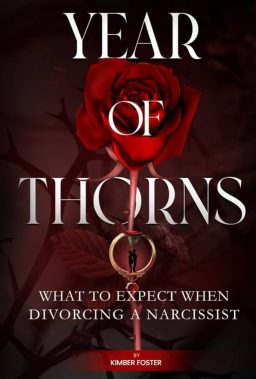























 Year of Thorns